
Writing is not one size fits all. The way we use language changes depending on who we’re writing for, what we’re writing about, and where our readers are. Customisation helps ensure that our words are not only correct, but also appropriate, natural, and effective in context.
InstaText, as an advanced editing assistant, supports this level of customisation for both academic and non-academic users. It allows you to adapt your writing to different dialects, formality levels, and languages, while preserving your individual tone and intent.
With the Language Settings feature, you can select between British and American English, choose a formal or informal style, and create a Personal Dictionary to prevent specific terms or word combinations from being changed.
In addition to English, our flagship service, InstaText, now supports editing in other languages, including Spanish, French, German, Italian, and Portuguese, making high-quality editing accessible to users worldwide.

See also: High-quality multilingual editing with InstaText
Why dialect settings matter
English is used globally, but it’s not uniform. Differences between British and American English go beyond spelling – they include variations in grammar, punctuation, and vocabulary that shape how readers perceive your writing.
For example:
- Spelling: “colour” (UK) vs. “color” (U.S.)
- Vocabulary: “flat” (UK) vs. “apartment” (U.S.), “holiday” (UK) vs. “vacation” (U.S.)
- Prepositions and expressions: “at the weekend” (UK) vs. “on the weekend” (U.S.)
These differences may seem small, but they matter when writing for specific audiences. Academic publishers in Europe usually expect British English, while companies and clients in North America prefer American English. Choosing the right dialect for your context – and using it consistently – makes your writing clearer, more professional, and more effective.
InstaText allows you to:
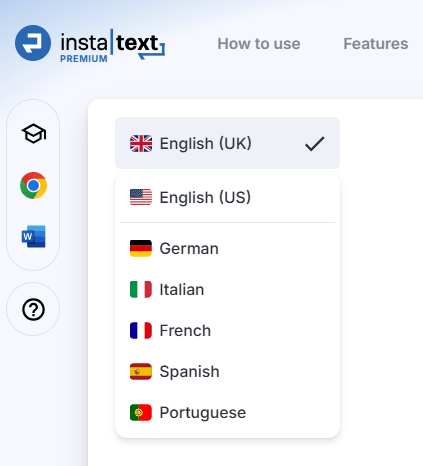
- Manually choose between UK or U.S. English
- Automatically adjust spelling, grammar, and vocabulary to match the selected version
By setting the right dialect, you make your writing consistent with the expectations of your readers, whether they are journal reviewers, colleagues, or clients.
See also: British vs. American English: Key differences
Formality adjustment for tone and context
The right tone is essential for effective communication. Writing that sounds too casual in an academic paper can appear unprofessional, while overly formal wording in a short email may feel distant.
InstaText’s formality adjustment helps you adapt the tone of your writing to match your purpose and audience. You can select formal, informal, or auto mode:
– Formal style enhances clarity and professionalism – suitable for academic writing, reports, business documents, and professional correspondence.
– Informal style makes text sound more conversational, natural, and engaging – ideal for personal messages, social media, or internal communication.
Example:
- Formal: “The results indicate a significant improvement in accuracy.”
- Informal: “The results show things got much better.”
This feature ensures that your writing always fits the situation, improving both readability and audience engagement.

See also: Avoid reader fatigue: Keep readers engaged with InstaText
Personal Dictionary for consistency and efficiency
Writers often use specialised vocabulary that generic editing tools fail to recognise. Academics rely on technical terms such as gene expression or quantum coherence, while professionals frequently use product names, brand terms, or specific expressions unique to their field.
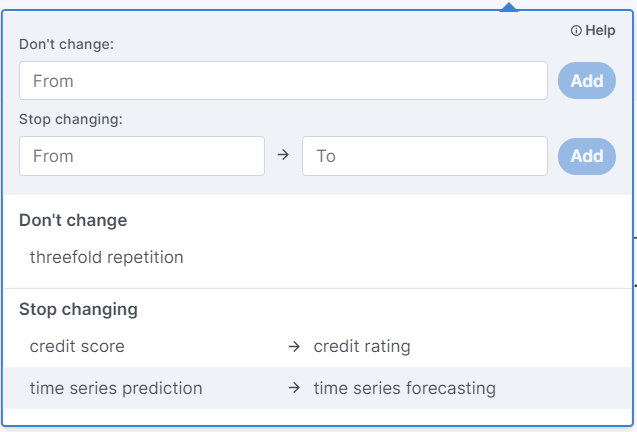
InstaText’s Personal Dictionary allows you to retain words and word combinations exactly as you want them to appear. You can add both individual terms (e.g. photosynthesis, blockchain) and multi-word expressions (e.g. CRM system, customer success strategy, finite element model).
Once added, these terms are preserved across all your edits. This ensures accuracy, saves time, and helps maintain your personal or professional writing style. It also prevents InstaText from altering key phrases that define your expertise or brand identity.
Non-English editing support
InstaText’s customisation capabilities extend beyond English. The platform now supports editing in major languages such as Spanish, French, German, Italian, and Portuguese.
This feature helps professionals, academics, and everyday writers express themselves clearly and confidently in their preferred language. You can switch between languages anytime in the Editor or browser extension.
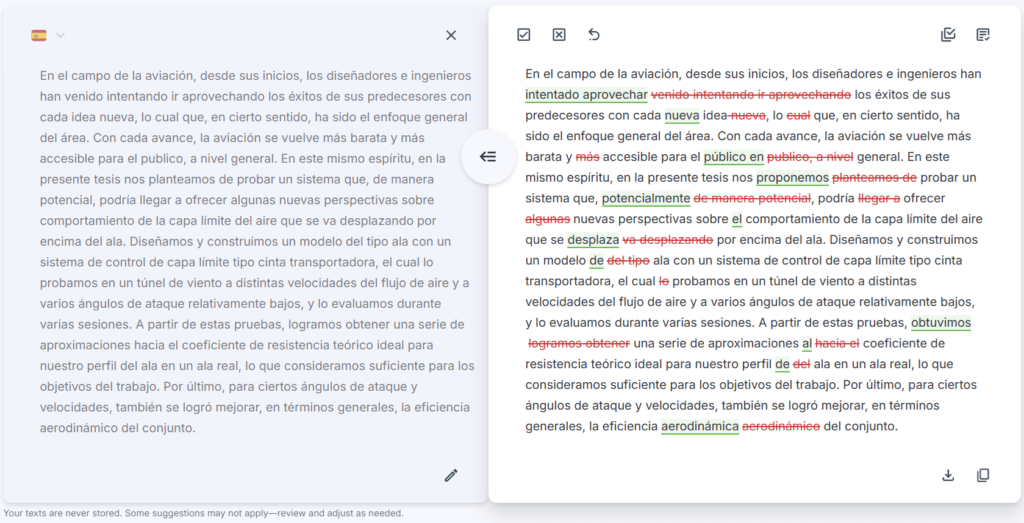
All languages benefit from InstaText’s deep editing technology, which improves clarity, structure, and readability while preserving the writer’s tone and intent.
Your voice, meaning, and authorship are preserved – InstaText improves how your ideas are expressed without generating new content. This is especially important in academic and professional contexts where originality is required.
Tailored writing for a global audience
Language Settings give you full control over how your writing sounds and feels. They help you:
- Match the right dialect to your target readers
- Choose the tone that fits your purpose
- Keep your specialised terminology consistent
In a global and multilingual world, effective communication depends on these details. InstaText’s language Settings bring them all together, making it easier to adapt, refine, and personalise your writing – without losing your authentic voice.

In addition, InstaText’s interactive feedback lets you accept or reject suggested edits. This gives you full control over your text, ensuring it reflects your intent and personal style.
See also: Tips for culturally aware writing
If you haven’t tried InstaText yet, visit instatext.io to explore Language Settings and experience how simple adjustments can make your writing clearer, more natural, and more professional in any language.


What our users say
“I find InstaText very helpful. It makes me much faster in writing papers. I’m a perfectionist and usually spend (way too) much time finding the right words and making sure that sentences are easily readable even if the concepts are arbitrarily complicated. InstaText makes my life easier. I recommend it to any PhD student or researcher, whether a native English speaker or not.”
— Giulia Guidi, PhD Student, University of California, Berkeley
“It has been incredibly liberating to not agonize over every last word, secure in the knowledge that the AI has my back and will smooth out the occasional rough edge. That freedom alone boosted my daily word counts by more than 10%, which is gold dust!”
— Matthew Siege, Writer
“InstaText is a great tool! I use it to improve English texts such as articles, projects and abstracts for conferences. The tool provides very useful suggestions that help me to translate the text to a professional level so that no additional review by “native speakers” is required. The time and money savings are obvious. I highly recommend it!”
— Dr. Janez Konc, Senior Researcher
