
- InstaText vs. generative AI tools
- InstaText vs. proofreading tools
- InstaText’s additional advantage: Multilingual support
InstaText, generative AI tools like ChatGPT, and proofreading solutions like Grammarly are often used in writing workflows, but they are built for very different goals.
In simple terms, InstaText edits and improves your own text, generative AI tools create new text, and proofreading tools mainly correct grammar and spelling.
Understanding this difference is essential for choosing the right tool for academic, professional, and everyday writing. Below is an in-depth overview of how these three types of tools compare in practice.
InstaText vs. generative AI tools
Purpose: Editing your text vs. generating new text
The most fundamental difference between InstaText and generative AI tools lies in what they are designed to do.
InstaText uses advanced language technologies for editing, but it is not a generative AI tool. It works on the text you write, rather than creating text from scratch. It improves clarity, structure, and wording without adding new ideas or changing the message. The goal is to help you express your own thoughts more clearly and professionally.

Generative AI tools are designed to create content. When asked to “edit” a text, they usually generate a new version based on patterns learned from large datasets. This often leads to substantial changes in phrasing, structure, and sometimes tone or emphasis, which may go beyond what is necessary or originally intended and affect interpretation.
See also: Why InstaText edits are not AI-generated
| Technology | Generative AI | Non-generative advanced language technologies |
| Definition | Creates new content based on input data | Analyses, processes, or improves existing content |
| Primary use | Content generation and creative tasks | Text analysis, editing, and comprehension tasks |
| Interaction method | Prompt-based: Yes ✅ (Users provide specific prompts to create new content.) | Prompt-based: No ❌ (Users input existing text for editing or analysis.) |
| Examples | ChatGPT DALL·E Midjourney Canva (Magic Write) Copy.ai | Google Translate IBM Watson Natural Language Understanding Google Cloud Text-to-Speech InstaText |
Authorship, originality, and academic use
With InstaText, authorship remains clear. Every sentence in the final version originates from the user, and every suggested change is visible and optional. This makes it suitable for academic papers, professional documents, and any situation where traceability and ownership of wording matter.
With generative AI tools, the rewritten text is produced by the system. This makes it harder to track changes and to guarantee that the final text fully reflects the author’s original intent.
This difference is critical in academic and other sensitive contexts. InstaText does not generate new content or introduce information, which avoids the risk of fabricated facts or references. As a result, it aligns well with academic publishing standards and university policies.
By contrast, many journals and institutions restrict or prohibit the use of generative AI tools due to concerns about authorship, originality, bias, AI hallucinations, and confidentiality.
See also: Why InstaText is your best bet for getting published
User control
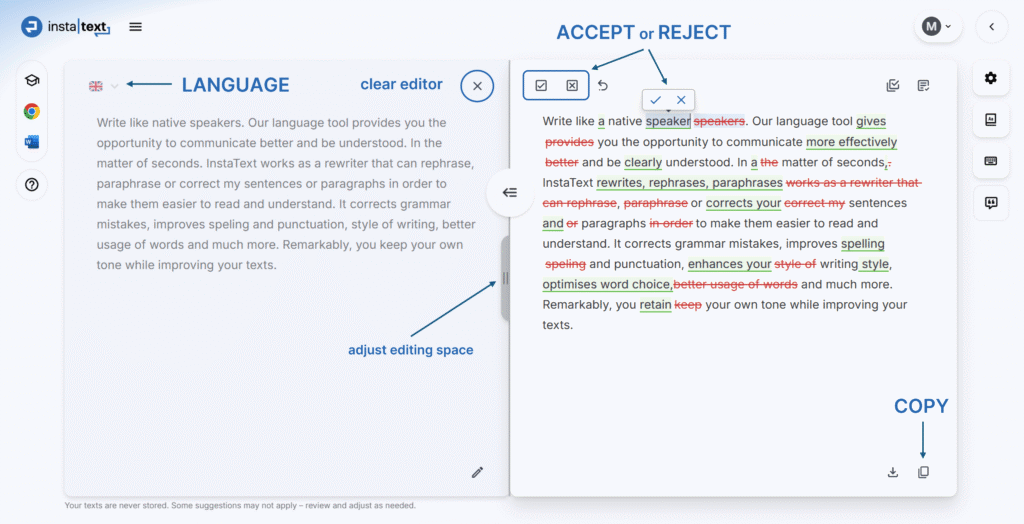
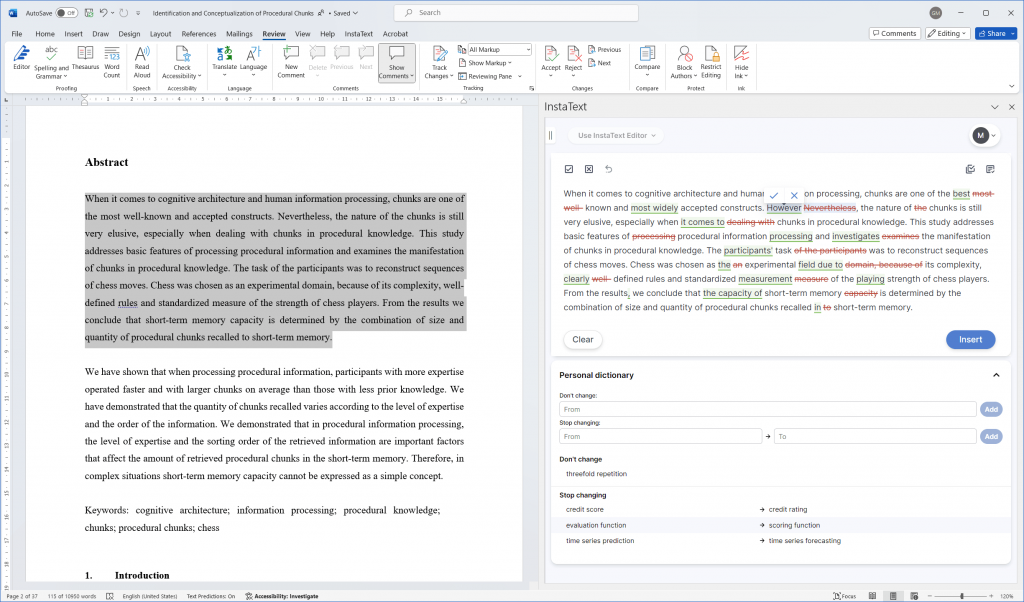
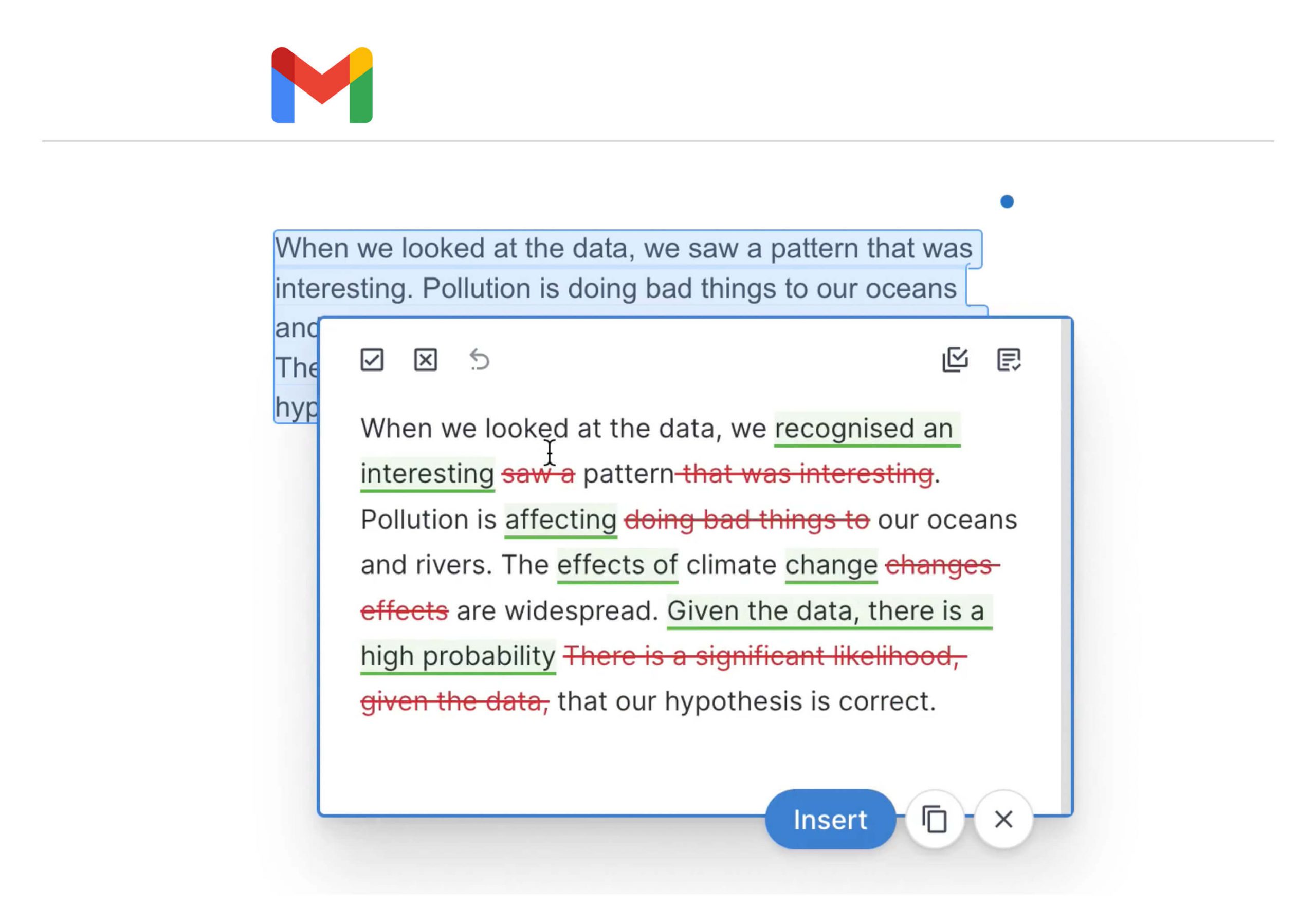
InstaText gives users full control over every change. Suggestions appear directly inside the text and can be accepted or rejected one by one. Nothing is applied automatically, and all edits remain visible.
Generative AI tools return a new version of the text rather than showing individual edits. Fine-grained control is limited, and the editing process is not transparent.
Speed, integrations, and everyday workflow
There is also a practical difference in how these tools fit into everyday writing workflows.
InstaText provides instant editing without prompts and integrates directly into over 20 commonly used platforms through its browser extension. It can also be used in Microsoft Word on both desktop and web, with Track Changes support. This allows users to edit where they already write – without switching tools or tabs, or copying text back and forth.




















Generative AI tools typically require repeated prompting and operate outside the user’s normal writing environment, which can slow down the editing process and interrupt workflow.
See also: InstaText vs. generative AI tools
Writing and cognitive skills development
InstaText encourages active engagement in the editing process. By reviewing and accepting or rejecting suggestions, users remain involved in shaping their own text. Over time, this supports the development of writing and cognitive skills, helping users recognise patterns, learn from mistakes, and communicate more clearly.
Generative AI tools, by contrast, tend to deliver a one-click rewritten result. While convenient, this offers fewer opportunities to understand individual changes or build long-term writing and cognitive skills that are essential in almost every profession.
See also: How InstaText improves writing and cognitive skills
Summary: InstaText vs. generative AI tools
Key differences
- InstaText edits existing text, while generative AI tools generate new text.
- InstaText preserves the author’s voice and intent, while generative AI tools often reformulate the text beyond what was originally intended.
- InstaText provides full control over individual changes, while generative AI tools offer limited transparency and control.
- InstaText avoids introducing new information or fabricated content, while generative AI tools can sometimes do so.
- InstaText aligns well with academic writing and contexts where authorship, authenticity, and originality matter, while generative AI tools are often prohibited, restricted, or not personally preferred in these settings.
- InstaText supports long-term writing and cognitive skills development through interactive, in-text editing, while generative AI tools typically offer limited learning value.
Quick comparison
| Aspect | InstaText | Generative AI tools |
| Creates new content | No | Yes |
| Editing approach | Improves the original text | Generates a new version |
| User control over changes | Full | Limited |
| Academic compliance | High | Often restricted |
| Risk of fabricated content | None | Possible |
InstaText vs. proofreading tools
Purpose: Improving communication vs. fixing mistakes
The main difference between InstaText and proofreading tools lies in how deeply they improve a text.
Proofreading tools focus primarily on correctness. They are effective at detecting and fixing grammar, spelling, punctuation, and some basic wording issues. Their purpose is to ensure that a text meets basic standards of language accuracy.
InstaText includes grammar and spelling correction, but its purpose is different. It is built to improve how ideas are communicated, not just whether sentences are correct.
This distinction matters because editing is often considered the most important phase of the writing process. It is where ideas are shaped into clear and well-structured communication. Grammar and spelling alone are not enough to achieve this level of quality. Deep editing is what turns correct text into effective communication.

See also: How InstaText helps improve your communication
Editing depth and quality
Proofreading tools usually do not restructure sentences in a meaningful way, improve logical flow between ideas, or refine how arguments and explanations are presented. A text can be grammatically correct and still be unclear, repetitive, or difficult to read.
InstaText performs deep language editing. It improves clarity, word choice, conciseness, flow, tone consistency, readability, and overall impact. It transforms rough or dense writing into clear, natural, professional language while preserving the original meaning and the author’s voice.

This difference is especially important in academic and professional contexts, where quality of expression matters as much as correctness.
User control and learning effect
InstaText shows suggestions directly in the text and allows users to accept or reject each change. This transparency helps writers understand why edits are suggested and gradually improve their own writing skills as well as their cognitive abilities.
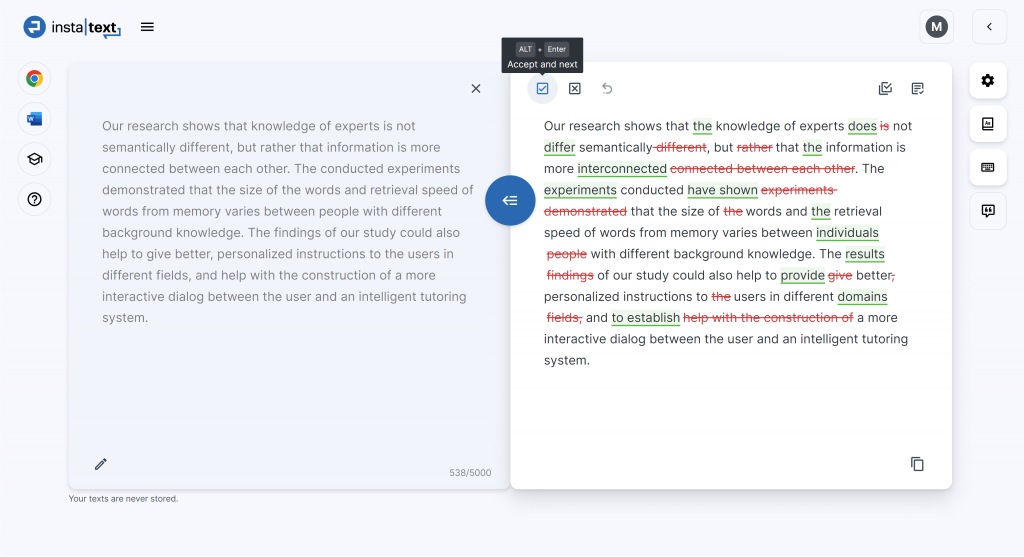
Proofreading tools also typically show suggested changes and allow users to review them, but the feedback is usually more limited in scope and depth. They are effective at fixing errors, but the number and type of suggestions tend to focus on surface-level issues, which contributes less to long-term writing and cognitive development compared to a dedicated editing assistant.
In addition, they sometimes present multiple alternative suggestions for the same issue, which can be confusing or overwhelming for some users and, in some cases, lead to decision fatigue and a slower editing process.
See also: InstaText vs. proofreading tools
Summary: InstaText vs. proofreading tools
Key differences
- InstaText improves not just grammar and spelling, but also clarity, structure, and overall expression, while proofreading tools focus mainly on grammar and spelling.
- InstaText focuses on communication quality, while proofreading tools focus on correctness.
- InstaText performs deep language editing, but proofreading tools usually make sentence-level fixes.
- InstaText supports long-term writing and cognitive skills development, while proofreading tools offer limited support in this area.
- InstaText helps strengthen how ideas are conveyed, but proofreading tools mainly help avoid language mistakes.
Quick comparison
| Aspect | InstaText | Proofreading tools | |
| Grammar and spelling correction | Yes | Yes | |
| Editing approach | Deep language editing | Error correction | |
| User control over individual changes | Full (accept or reject each edit) | Varies by tool | |
| Writing and cognitive skills development | Strong | Limited | |
| Typical editing depth | Paragraph and document level | Sentence level |
InstaText vs. generative AI vs. proofreading tools
To summarise the two comparisons above, InstaText occupies a different position from both generative AI and proofreading tools. The table below brings these three approaches together in a single overview.
| Aspect | InstaText | Generative AI tools | Proofreading tools |
| Primary purpose | Improve and refine existing text | Generate new text | Fix language errors |
| Creates new content | No | Yes | No |
| Typical editing approach | Deep language editing and refinement | Content generation and reformulation | Error detection and correction |
| Grammar and spelling correction | Yes | Yes | Yes |
| Editing depth | Paragraph and document level | Variable | Mostly sentence level |
| Sentence restructuring | Yes | Yes | Rare |
| User control over individual changes | Full (accept or reject each edit) | Limited | Varies by tool |
| Transparency of changes | High | Low | Varies by tool |
| Authorship preserved | Yes | Not always clear | Yes |
| Risk of fabricated content | None | Possible | None |
| Academic compliance | Allowed | Often restricted | Allowed |
| Writing and cognitive skill development | Strong | Limited | Limited |
| Workflow integration | Broad workflow integration (browser extension across 20+ platforms + Microsoft Word) | Usually separate interface | Varies by tool |
InstaText’s additional advantage: Multilingual support
In addition to its editing approach, InstaText offers professional multilingual editing support, which is especially valuable for writers with international audiences, multilingual writers, and global teams.
See also: How InstaText enhances team collaboration
It supports editing in six major languages (English, Spanish, French, German, Portuguese, and Italian), as well as in more than 40 additional local languages depending on the region (such as Slovenian, Malay, and Hindi). Quick language switching is available directly inside the editor.
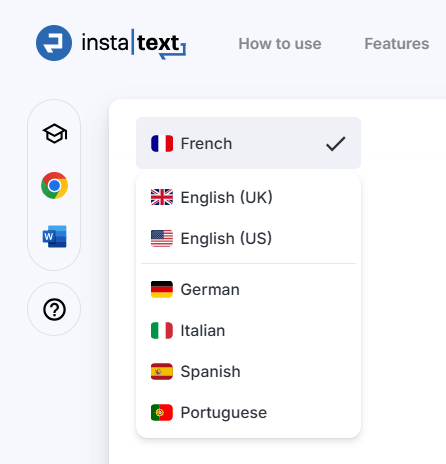
This allows users to improve clarity, structure, and tone in different languages with high precision and in-depth edits, without having to rely on separate tools or interrupt their workflow.
See also: High-quality multilingual editing with InstaText
For researchers, students, and professionals working across borders, this makes InstaText practical not only as an English editing tool, but as a consistent writing companion for multilingual communication.

Where InstaText stands
As discussed, InstaText plays a different role in the writing process than both generative AI and proofreading tools.
Unlike generative AI tools, it does not create or rewrite content beyond what is necessary or originally intended. Unlike proofreading tools, it goes beyond grammar and spelling to improve clarity, word choice, readability, and overall impact.
InstaText focuses on deep, precise editing that refines how ideas are communicated while preserving authorship, meaning, and user control.
For writers who value clarity, originality, academic acceptance, and long-term improvement, InstaText offers a practical solution for both academic and non-academic work.
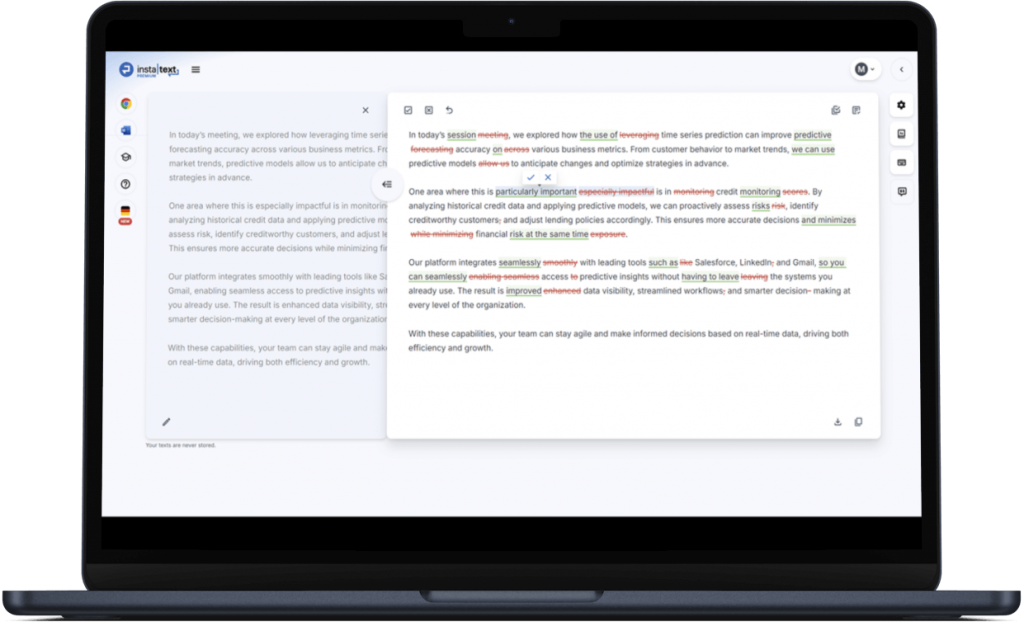
If you haven’t used InstaText yet, you can start with the Free plan to see how its editing approach works in practice and how interactive feedback improves your text while keeping you in full control of your writing.
If you’re already a subscriber, you can check out our blog for further insights, tips, and examples on how to get the most out of InstaText as an advanced editing assistant.
What our users say
“I absolutely recommend InstaText to all academic writers who have to publish their work in English and would like to have their work accepted and not rejected just because the language is not up to the standards demanded by the journal.”
— Dr. Karmen Pižorn, Professor of English Education
“This tool is outstanding, exceeded my expectations. I’m used to using Grammarly but InstaText is a more thorough tool and comes up with much better suggestions for rewrites. A game changer for editing.”
— Stephan Skovlund, Business Consultant
“InstaText has completely changed the way I write and communicate in academic papers, social media, and other areas. I definitely recommend this tool for non-native speakers who usually struggle with their English skills. I wish I had learned about InstaText sooner.”
— İbrahim Niftiyev, PhD Researcher

