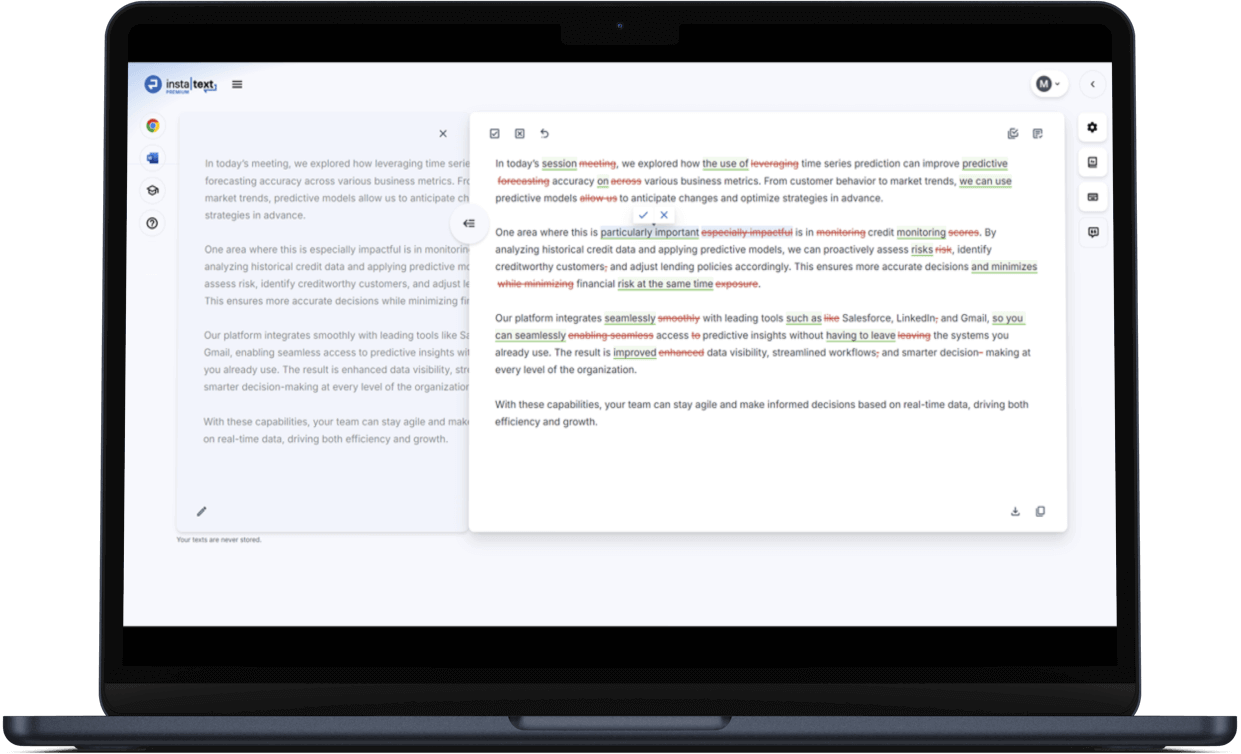
- Speed, integrations, and multilingual support
- Privacy and confidentiality
- Specialised editing beyond proofreading
- Full user control, transparency, and voice preservation
- Authorship, originality, and academic compliance
- Writing and cognitive skills development
InstaText and generative AI tools, such as ChatGPT, are sometimes compared because they are both used in writing workflows, but they are fundamentally different.
Generative AI tools are designed to create new content based on patterns learned from large datasets. When you ask them to edit something, they typically produce a new version of your text.
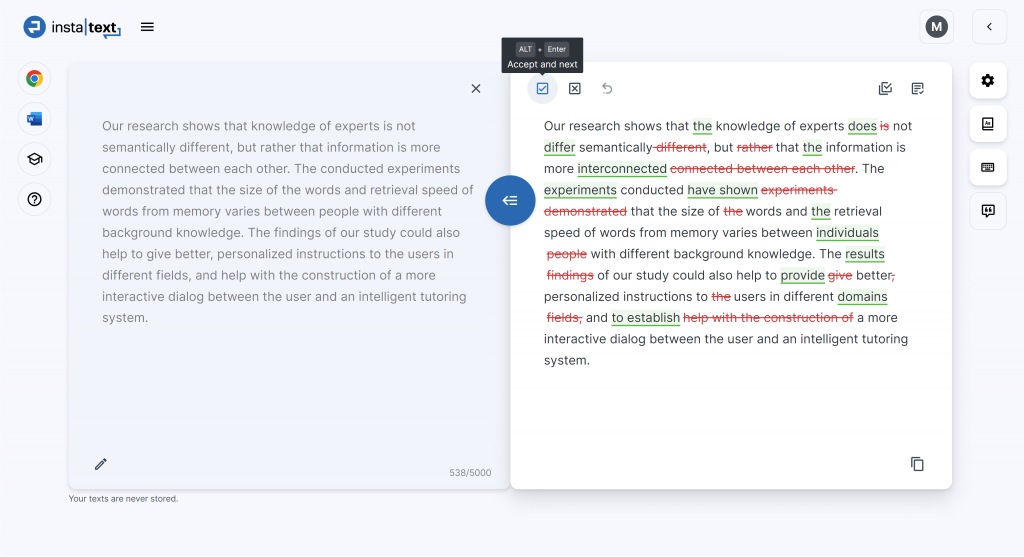
InstaText takes a fundamentally different approach from generative AI tools. It improves the text you write – without creating new content, adding ideas, or changing your core message. Every change is a visible suggestion you can accept or reject.
Because of this difference, the two types of tools serve different roles in practice. Below are the areas where InstaText offers specific advantages for both academic and non-academic writing.
Speed, integrations, and multilingual support
InstaText provides instant editing after users write or paste their text. There is no need to write prompts, explain what kind of edit is required, or repeat instructions.


In addition to being available as a web-based editor, InstaText integrates directly into everyday writing environments, including:
- Browser extension supporting 20+ apps (including Google Docs, Gmail, LinkedIn, and Overleaf)

- Microsoft Word on both desktop and web, with Track Changes support
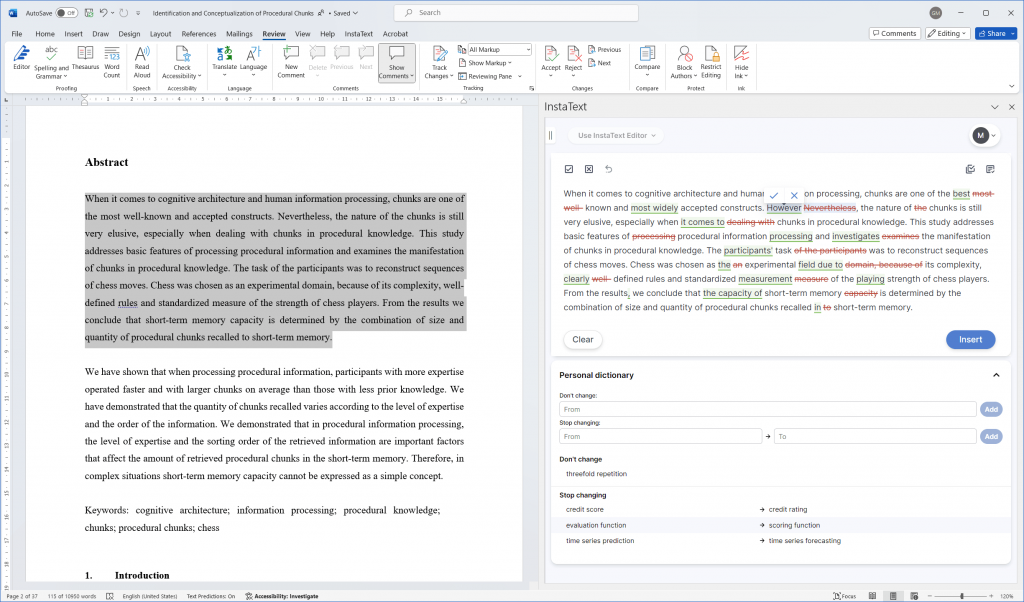
This allows writers to edit where they already work, without copying text, switching tabs, or changing tools, which significantly speeds up everyday writing and editing.
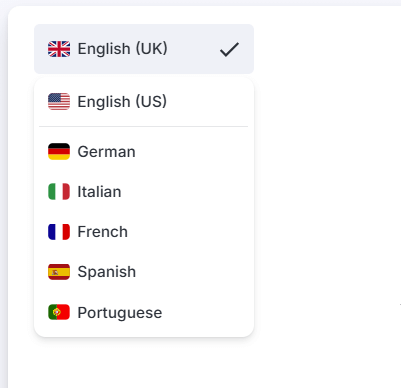
InstaText also supports multilingual editing at a professional level, available with quick language switching across:
- English plus 5 major languages (Spanish, French, German, Italian, Portuguese)
- 40+ additional local languages – depending on region
This makes it practical for international researchers, multilingual professionals, and global teams.
Privacy and confidentiality
InstaText never stores user content. It processes text only when users choose to submit it for improvement and follows EU data protection regulations. This makes it suitable for users who are cautious about using generative AI tools that keep usage history or reuse data.
It also aligns with publisher and reviewer policies that restrict or prohibit the use of generative AI tools in confidential review and evaluation processes, due to concerns about data exposure, bias, and misuse.
“This tool is outstanding, exceeded my expectations. I’m used to using Grammarly but InstaText is a more thorough tool and comes up with much better suggestions for rewrites. A game changer for editing.”
— Stephan Skovlund, Business Consultant
Specialised editing beyond proofreading
InstaText is built specifically for editing, not for conversation or content generation. It offers high-precision, in-depth language editing and goes far beyond basic grammar and spelling checks. It improves key aspects of writing, such as:
- clarity
- word choice
- conciseness
- flow
- readability
- overall impact
This matters because editing is often considered the most important phase of the writing process. It is where ideas become precise, structure becomes coherent, and language becomes credible.

Full user control, transparency, and voice preservation
InstaText gives users complete control over every change. Suggestions appear directly inside the text and can be accepted or rejected. Nothing is applied automatically, and all changes are visible.
This balance between deep editing, user control, and preserving the author’s voice and intent is especially important in academic, technical, legal, and journalistic writing, where even subtle, unintended changes in wording or tone can alter interpretation.
Generative AI tools, such as ChatGPT, in contrast, typically return a fully rewritten version of the text, which can make it harder to track changes or control subtle shifts in tone and meaning.

Authorship, originality, and academic compliance
InstaText works only on the text you write and improves how your ideas are expressed.
This preserves authorship and originality, which are essential in professional contexts such as academic publishing. Many journals and universities restrict or prohibit the use of generative AI tools due to concerns about confidentiality, bias, and unclear authorship.
| Technology | Generative AI | Advanced editing (non-generative) |
| Definition | Creates new content based on input data | Analyses, processes, or improves existing content |
| Primary use | Content generation and creative tasks | Text analysis, editing, and comprehension tasks |
| Interaction method | Prompt-based: Yes ✅(Users provide specific prompts to create new content.) | Prompt-based: No ❌(Users input existing text for editing or analysis.) |
| Examples | ChatGPT DALL·E Midjourney Canva (Magic Write) Copy.ai | Google Translate IBM Watson Natural Language Understanding Google Cloud Text-to-Speech InstaText |
Because InstaText never adds information or rewrites ideas, the intellectual ownership of the text remains clearly with the writer.
Everything in the improved version comes directly from the original text. This removes the risk of AI hallucinations, including fabricated facts, invented references, and unverified additions.
“I am a translator and proofreader by profession and have tried many editing tools. It’s not an exaggeration to say that all the other apps I’ve used so far don’t come close to InstaText. It is literally innovative and revolutionary and has taken the editing game to a new level, leaving other competitors in the dust.”
— Dr. Ghodrat Hassani, Researcher in Translation Studies
Writing and cognitive skills development
InstaText’s interactive feedback creates strong benefits for the development of writing and cognitive skills. By actively engaging with suggestions and mindfully accepting or rejecting them, users can recognise patterns, identify mistakes, learn new words and structures, and gradually improve their writing.
This emphasis on thoughtful revision, rather than full automation, also supports deeper cognitive skill development, benefiting students, researchers, professionals, and non-native speakers who seek long-term improvement, not just a quick fix.
InstaText vs. generative AI tools – overview
| Aspect | InstaText | Generative AI |
| Primary purpose | Edit and improve existing text | Generate new text |
| User control | Full control over each change | Limited control over output |
| Voice and intent | Preserved | May change |
| Risk of hallucinations | None | Possible |
| Academic and professional use | Suitable and compliant | Often restricted |
| Workflow integration | Works inside 20+ platforms | Mostly chat-based |
| Writing and cognitive skills development | Strong | Limited |
InstaText: For writers who value originality, control, and growth
The bottom line is that for writers who care not only about producing text, but about actively engaging with it, owning it, understanding it, and becoming better writers and thinkers over time, InstaText is an ideal choice.
By focusing on editing rather than generation, it preserves authorship and intent, gives full control over every change, avoids hidden additions, and makes revision an active learning process. At the same time, its integrations and multilingual support make it practical for everyday professional use.
In academic, technical, and professional settings, where precision and text quality matter as much as speed, this combination makes a meaningful difference.
If you haven’t tried InstaText yet, you can start with the Free plan and see for yourself how it differs from editing with ChatGPT, Claude, Gemini, and other generative AI tools.

See also: InstaText Editor
What our users say
I find InstaText very helpful. It makes me much faster in writing papers. I’m a perfectionist and usually spend (way too) much time finding the right words and making sure that sentences are easily readable even if the concepts are arbitrarily complicated. InstaText makes my life easier. I recommend it to any PhD student or researcher, whether a native English speaker or not.”
— Giulia Guidi, PhD Student, University of California, Berkeley
“Of course, there’s Grammarly, a writing assistant that checks the spelling, grammar, punctuation, and clarity of your writing, corrects common errors, and occasionally gives you suggestions for rewording. The thing about Grammarly, though, is that it’s a good proofreader, but not an editor. And, as any skilled writer will be happy to tell you, the editing is the secret.”
— Jim Stonos, Writer and Editor
“I can hardly imagine writing articles without InstaText. When I read through the proposed improvements, I immediately understand how the text should sound. It’s like a proofreader you can access at any time.”
— Dr. Jana Krivec, Senior Lecturer

