
- Role of human editors and proofreaders
- What InstaText is designed to do
- How much of the editing InstaText handles
- Multilingual editing as a core advantage
- Speed, availability, and iteration
- Cost efficiency and scalability
- Accuracy, consistency, and user control
- Privacy, sensitivity, and comfort
- Where human editors remain relevant
- InstaText: A modern, reliable editing solution
Despite major advances in language technology, some writers still prefer human editors and proofreaders for reasons including scepticism toward technology, privacy concerns, institutional norms, trust in human judgment, and reassurance in high-stakes or evaluative contexts.
Human editing does offer value, particularly for final validation and sensitive texts. However, solutions like InstaText combine the efficiency of technology with active human involvement in the editing process, addressing many of these concerns while significantly reducing time and cost.
This article compares InstaText with human editors and proofreaders. The goal is not to dismiss human expertise, but to show how InstaText can handle most of the editing work efficiently and consistently, and how human review can be applied more selectively where it adds the most value.
See also: InstaText vs. proofreading tools
Role of human editors and proofreaders
Human editors and proofreaders continue to play an important role in many writing workflows.
Human editors typically work earlier in the process. They help improve clarity, structure, flow, and tone, and may also assess coherence, argumentation, and overall fit for the intended audience or context. In specialised fields, editors may bring subject-matter familiarity that helps identify nuanced issues.
Human proofreaders usually focus on the final stage of writing. Their work includes correcting spelling, grammar, punctuation, formatting issues, and ensuring consistency before submission or publication.
For writers who prefer to fully outsource editing and proofreading, whose drafts require extensive restructuring or rewriting because they are still developing their writing skills, or who require an additional layer of reassurance, human support remains a commonly chosen option.

See also: Is InstaText the ideal balance between AI and human writing?
What InstaText is designed to do
InstaText is an advanced editing assistant that works directly on the text the writer produces. It improves your existing text without generating new content or introducing new ideas. Every change is a suggestion you can accept or reject – so your voice, meaning, and authorship stay intact. InstaText refines clarity, structure, flow, wording, conciseness, and readability while preserving the author’s voice and intent.
By working only on existing text, InstaText reduces the risk of factual errors or unintended meaning shifts, thus minimising the need for extensive human editing. This is especially important in academic, technical, and professional writing.

See also: InstaText vs. generative AI tools
How much of the editing InstaText handles
In practice, once a draft is reasonably developed, InstaText can typically handle 90–95%, and in some cases up to 100%, of the language editing work, including:
- Grammar and spelling
- Sentence restructuring and clarity improvements
- Word choice and phrasing
- Flow, conciseness, and readability
- Tone consistency
After using InstaText, a short human review can help with formatting, punctuation details, style-guide requirements, or other minor issues. In most cases, this final pass is sufficient to make a text publication-ready or submission-ready in any supported language.
As a result, the role of human editing shifts from extensive intervention to a targeted final check. When writers still choose to involve a human editor or proofreader, the remaining work is usually limited in scope, resulting in lower cost and faster turnaround.
Multilingual editing as a core advantage
One of InstaText’s strongest advantages over human editing is multilingual coverage.
InstaText supports deep editing in six major languages (English, Spanish, French, German, Portuguese, and Italian), as well as over 30 additional local languages, depending on region. This makes it a more comprehensive solution than finding and coordinating separate human editors and proofreaders for different languages.
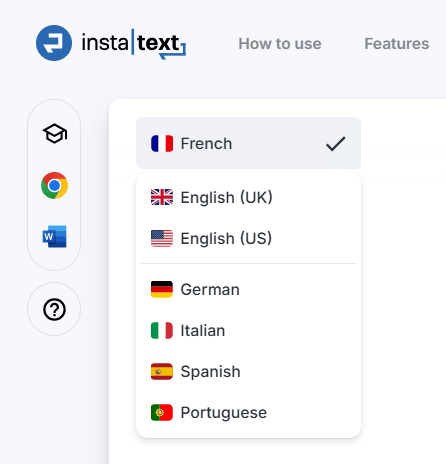
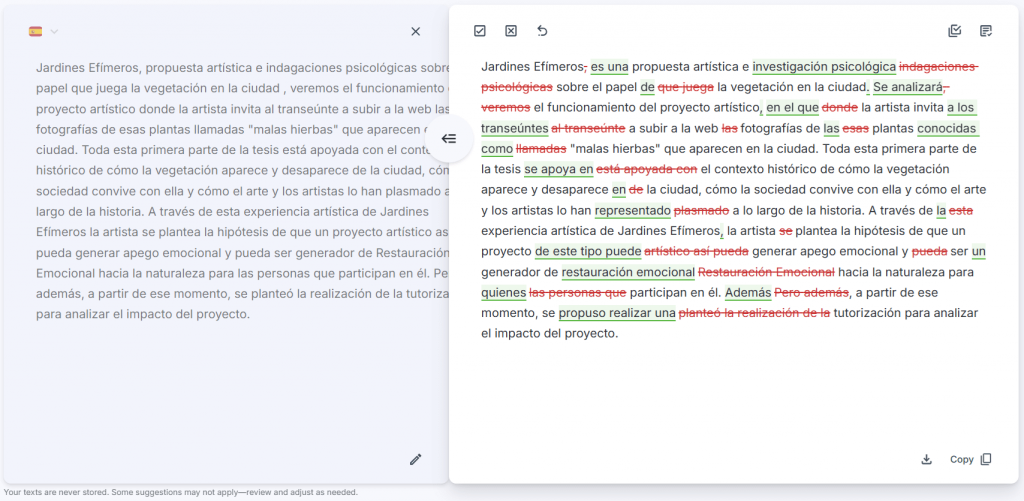
In addition to broad language coverage, InstaText is designed to help writers produce native-level writing across supported languages. Its editing quality has been refined through years of rigorous testing and multiple product upgrades, with a strong focus on natural phrasing, precise word choice, and tone consistency.
See also: High-quality multilingual editing with InstaText
At the same time, this breadth of language support does not come at the expense of edit quality. The same level of precision and naturalness is applied across all supported languages, addressing a common concern that multilingual editing may dilute quality.
This is especially valuable for non-native speakers, international researchers, professionals working across borders, and global teams, who can rely on InstaText to achieve fluent, natural language output.
Speed, availability, and iteration
Human editing requires coordination and availability. Turnaround times of 24–48 hours are common, and longer delays can occur when multiple revision rounds are needed.
InstaText works instantly and is available at any time. Writers can revise their text, review suggestions, and re-edit as often as needed, making it particularly useful for tight deadlines, last-minute changes, and iterative refinement.
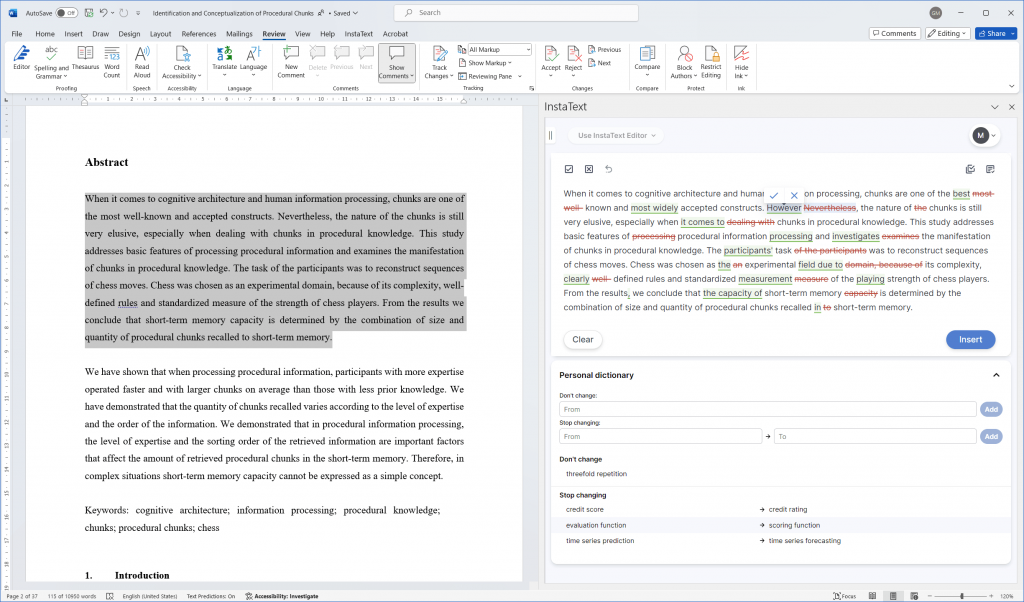



In addition, InstaText integrates directly into everyday writing environments through its browser extension, supporting over 20 commonly used platforms, including Google Docs and Overleaf, and is also available in Microsoft Word via a dedicated add-in.
This allows writers to edit directly where they already work, without copying and pasting text or switching between tabs or applications.


















Cost efficiency and scalability
Human editors and proofreaders typically charge per word or per page. For long documents, frequent writing, or multilingual projects, costs can add up quickly and vary depending on language, specialisation, and turnaround time.
In addition to monthly subscriptions, InstaText is available on an annual plan for under €120 per year, which translates to roughly €10 per month when billed annually and offers significant savings. This includes unlimited use across documents and supported languages.
For frequent writers, this model can be several times more cost-efficient than repeated human editing, while offering predictable costs and unlimited scalability.
See also: InstaText plans
Cost, time, and efficiency overview
| Aspect | InstaText | Human editors and proofreaders |
| Cost structure | Fixed subscription | Per word or per page |
| Typical turnaround | Instant | 24–48 hours or longer |
| Iteration speed | Unlimited and immediate | Limited and slower |
| Editing coverage | 90–95% of language editing | Full review |
| Multilingual support | 6 major + 30+ local languages | Usually language-specific |
| Scalability | Unlimited documents | Limited by availability and cost |
Accuracy, consistency, and user control
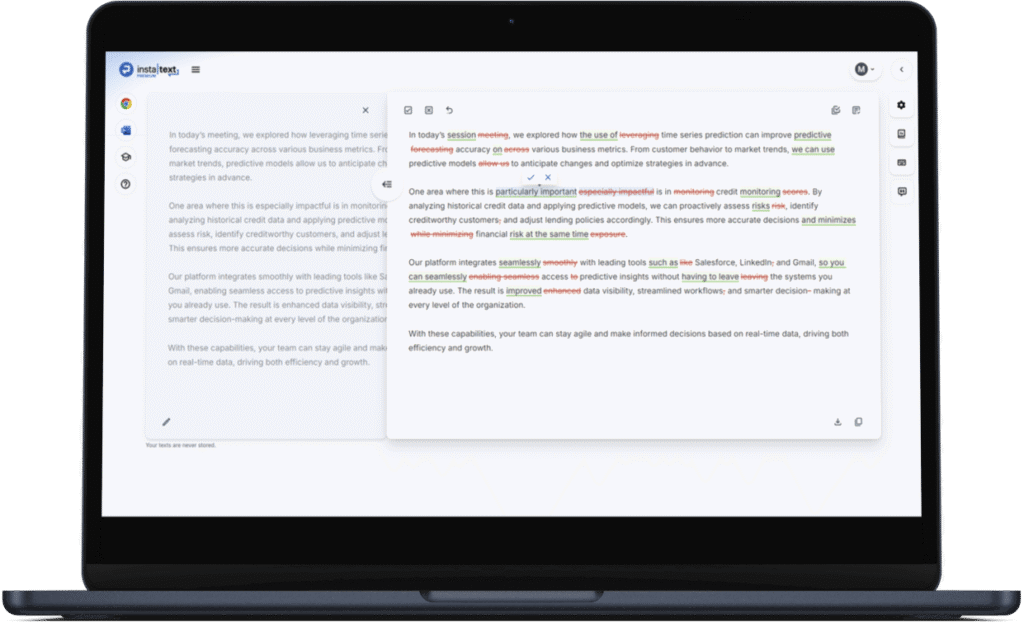
InstaText provides consistent editing across documents and gives writers full control over every suggested change. Suggestions appear directly in the text and can be accepted or rejected individually. Nothing is applied automatically.
This interactive feedback significantly reduces the risk of unintended errors, since writers remain actively involved in every decision and can immediately see the impact of each edit.
Human editors can deliver excellent results, but edits are typically applied as a batch, and revisions may introduce unintended changes that are only noticed later. Additional review rounds often require more time or cost.
Privacy, sensitivity, and comfort
Some writers prefer not to share drafts containing unpublished research, legal material, medical information, or early-stage ideas with others.
InstaText never stores user content. It processes text only when users choose to submit it for improvement and follows EU data protection regulations. This allows writers to edit privately, without sharing documents with other people.
For many users, this reduces friction and increases comfort during the editing process, particularly when working with sensitive material.
Where human editors remain relevant
Human editors and proofreaders remain valuable in certain situations:
- Full outsourcing for writers who want everything handled for them
- Deep subject-matter nuance in highly specialised fields
- In some academic contexts, journals or institutions may request confirmation that a manuscript has undergone professional language editing
Such requests are not universal and usually apply selectively, for example when language quality has previously been flagged. In these cases, a more extensive human review may still be required.
See also: InstaText vs. generative AI tools
InstaText: A modern, reliable editing solution
For many writers, an ideal workflow combines both approaches. Using InstaText for comprehensive language editing and refinement, followed by a short human review when needed, delivers high-quality results while saving time and cost. This workflow is effective across disciplines, languages, and writing contexts.
InstaText does not replace humans. It changes how, when, and to what extent they are involved. By handling most of the language editing work instantly, consistently, and across languages, InstaText allows human expertise to be applied more selectively, as a focused final refinement step.
For writers who value quality, control, scalability, and multilingual support, this results in faster turnaround, lower costs, and writing that reads naturally to native speakers.
If you have not tried InstaText yet, you can start with the Free plan and see for yourself how it reduces the need for extensive human review. If you are already a subscriber, you can explore our Features page and blog for further insights on how to get the most out of InstaText.
What our users say
“InstaText has completely changed the way I write and communicate in academic papers, social media, and other areas. I definitely recommend this tool for non-native speakers who usually struggle with their English skills. I wish I had learned about InstaText sooner.”
— İbrahim Niftiyev, PhD Researcher
“I absolutely recommend InstaText to all academic writers who have to publish their work in English and would like to have their work accepted and not rejected just because the language is not up to the standards demanded by the journal.”
— Dr. Karmen Pižorn, Professor of English Education
“This tool is outstanding, exceeded my expectations. I’m used to using Grammarly but InstaText is a more thorough tool and comes up with much better suggestions for rewrites. A game changer for editing.”
— Stephan Skovlund, Business Consultant

